
|
Product Details:
|
| NCO Content: | 23.0% ± 0.5% | Viscosity At 23 °C: | 1,200mPa·s ± 300mPa·s |
|---|---|---|---|
| Color Value (Hazen): | ≤ 40 | Monomeric HDI: | < 0.25% |
| Viscosity At 25 °C: | Approx. 1100mPa·s | Equivalent Weight: | Approx. 183 |
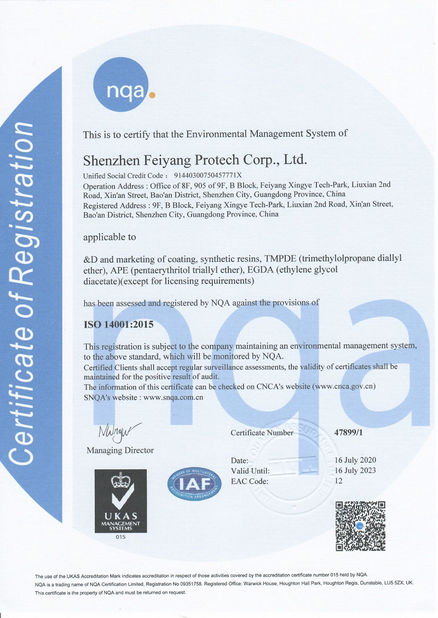
| Highlight: | ISO 14001 Desmodur N 3600,HDMI Hardener Desmodur N 3600 |
||
A hardener is a component of certain mixtures. ... A hardener can be either a reactant or a catalyst in the chemical reaction during the mixing process. In other combinations, a hardener is used as a curing component. A hardener may also be known as an accelerator.
1. Characterization
Aliphatic polyisocyanate (HDI trimer).
As the hardener component for lightfast polyurethane coating systems.
2. Specification
| Property | Value | Unit of measurement | Method |
| NCO content | 23.0 ± 0.5 | % | DIN EN ISO 11 909 |
| Viscosity at 23 °C | 1,200 ± 300 | mPa·s | DIN EN ISO 3219/A.3 |
| Color value (Hazen) | ≤ 40 | DIN EN 1557 | |
| Monomeric HDI | < 0.25 | % | DIN EN ISO 10 283 |
| Viscosity at 25 °C | approx. 1100 | mPa·s | DIN EN ISO 3219/A.3 |
| Equivalent weight | approx. 183 | ||
| Flash point | approx. 158 | °C | DIN 22 719 |
| Density at 20 °C | approx. 1.16 | g/ml | DIN EN ISO 2811 |
3. Solubility
Desmodur® N 3600 can be thinned with esters, ketones, and aromatic hydrocarbons such as ethyl acetate, butyl acetate, PMA, methyl ethyl ketone, methyl isobutyl ketone, cyclohexanone, toluene, xylene, solvent naphtha® 100 and mixtures thereof.
Generally speaking, it has good compatibility with the solvents listed. However, the solutions formed must be tested for their storage stability. Only PU-grade solvents should be used (max. 0.05 % water, absence of reactive hydroxyl or amino groups). Aliphatic hydrocarbons are unsuitable as solvents.
4. Thinnability
Desmodur® N 3600 should not be thinned to below a solids content of 40 %. Prolonged solution storage with a lower binder content may result in turbidity and sedimentation.
5. Compatibility
Generally speaking, Desmodur® N 3600 can be mixed with the following products: Aliphatic polyisocyanates like Desmodur® N 100, N 75, N 3200, ultra N 3300, N 3400 and Desmodur® Z 4470; aromatic polyisocyanates like Desmodur® L/ultra L, HL and IL/ultra IL; polyester polyols such as Desmophen® 670 and polyacrylates. However, the compatibility of the combinations used should be tested.
Desmodur® N 3600 is incompatible with branched polyester polyols such as Desmophen® 651 or polyether polyols such as Desmophen® 1380 BT.
6. Properties
Desmodur® N 3600 is primarily the hardener component for lightfast two-component polyurethane coatings with high chemical and weather resistance, good gloss retention, and outstanding mechanical properties. Preferred co-reactants are polyacrylate or polyester polyols.
7. Applications
The main applications for systems based on Desmodur® N 3600 are air- and force-drying coatings for automotive OEM, automotive refinishing, transportation, industrial finishing, and plastics.
Because of its low viscosity, Desmodur® N 3600 is particularly suitable for formulating high-solids coatings. It can also be used as the hardener for aqueous two-component polyurethane coatings.
8. Storage
- Storage in original sealed Covestro container.
- Recommended storage temperature: 10 - 30 °C.
- Protect from moisture, heat, and foreign material.
General information: The product is sensitive to moisture and should therefore be stored in tightly sealed containers. Storage at elevated temperatures will lead to an increase in viscosity and a reduction of the NCO content.
Contact Now
or Send Us an Email: marketing@feiyang.com.cn, feiyangjunyan@gmail.com
Elastic Hardener FEICURE Series
Our state-of-the-art facility, completed on April 16, 2024, is dedicated to the R&D, application, and advancement of cutting-edge polyaspartic polyurea materials. Backed by a team of more than 50 experts and industry leaders, it serves as a hub for innovation and technical excellence.
Our vision is to become a global leader in polyaspartic polyurea material R&D by mastering the core technologies of the entire industry chain. Through digitalization, smart systems, and intelligent manufacturing, we strive to deliver high-quality advanced material solutions to customers worldwide.

In July 2023, Feiyang launched the design and construction of a new 26,000-ton polyaspartic materials project. Upon full operation, the project will raise Feiyang’s total resin production capacity to 46,000 tons. It has significantly upgraded the original polyaspartic resin production process by establishing a fully automated production line that integrates raw material storage, manufacturing, and packaging. As a result, labor requirements have been reduced by 50%, while output per employee has doubled. In addition, the upgraded production line now enables the direct production of high-purity bio-based polyaspartic polyurea resin.

Contact Now
or Send Us an Email: marketing@feiyang.com.cn, feiyangjunyan@gmail.com
Polyaspartic Polyurea Industry Standards
Oil and gas overhead pipeline anti-corrosion and insulation technology standard, coded as SYITT34 72016.
Standard for polyaspartic polyurea anti-corrosion coatings. In 2018, HG/T5368-2018 was promulgated.
Polyaspartic polyurea waterproof coatings. Group standards HG/T5368-2018 was promulgated in 2021.
Polyaspartic polyurea sealant. Group standard to be issued in 2021.
Polyaspartic polyurea waterproof glue for building exterior wall. Group standard was started in 2018.
Polyurea automotive paint standard, jointly formulated by FAW, Feiyang, etc. In 2015, FAW enterprise standards were formulated, similar to industry standards.
Contact Person: Annie Qing
Tel: +86 18307556691
Fax: 86-183-07556691


 English